 Stashwise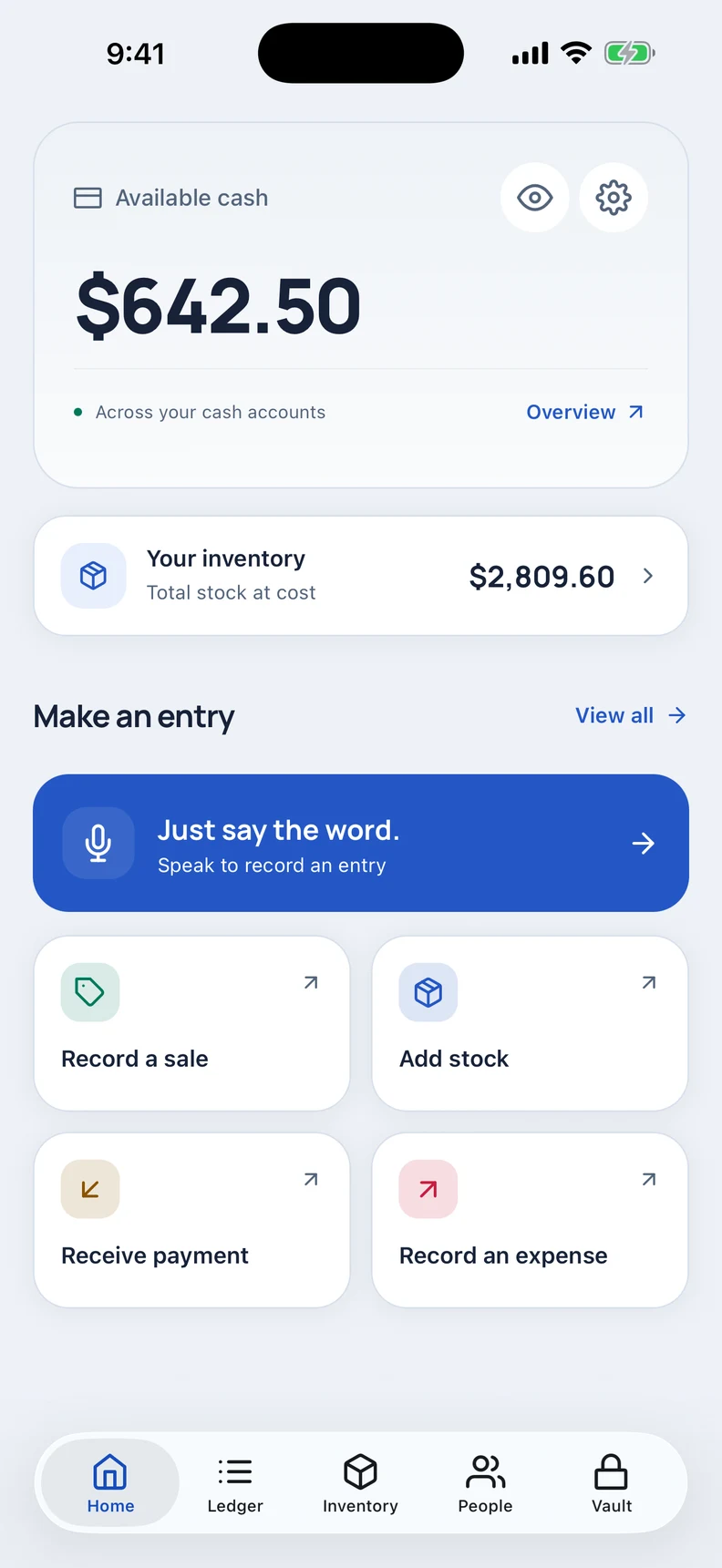
1. Write down your starting position
Before the first sale, count your stock and opening cash float. Keep that starting cash separate from the sales you make during the day: bringing change to the stall is not a sale.
- List each item and the quantity you brought.
- Record the cash float and where you keep it.
- Carry forward any amounts customers already owe you.
2. Capture each sale while it is fresh
Record the item, quantity, total amount and how the customer paid. If payment will come later, add the customer and the amount owed. A short entry now is easier than trying to remember several similar purchases at closing time.
In Stashwise, you can enter a sale on your phone or use voice entry. Check the interpreted details before confirming. Core recording works offline; optional server-assisted voice needs a connection.
3. Keep expenses and payments distinct
Record stall fees, packaging and other costs as expenses. Note which account paid each one. When someone pays an earlier balance, record a payment rather than another sale. This keeps sales activity separate from money moving in and out.
4. Check the numbers with a simple example
Suppose you bring 30 candles and a $50 cash float. You sell 8 candles for $10 each: 5 are paid in cash and 3 by bank transfer. You also pay a $20 stall fee from your cash box.
With no other movements, you should have 22 candles left, $80 in sales, $30 received by bank transfer and $80 in the cash box ($50 opening float + $50 cash sales − $20 stall fee).
The $80 cash-box balance is not your sales total or your profit. Profit also depends on the cost of the candles and other relevant expenses. Keeping these figures separate makes the day easier to understand.
5. Investigate differences before packing away
Count remaining stock and cash, then compare them with your records. Look for an unrecorded sale, an expense paid from the cash box, a return or an entry assigned to the wrong account. Record the actual event once you identify it.
Keep receipts and the detail behind your entries. Repeat the same routine each market day so your records remain comparable.
Use Stashwise for the same routine on your phone
Guided setup helps you enter cash, stock and opening balances. Ledger holds your entries, Inventory shows stock, and People brings customer balances together. Monthly stats and the recap help you review the bigger picture.
Stashwise is a private app for iOS and Android. Your books are encrypted on your phone and no account is needed. Use the beta signup to ask about current testing access.